
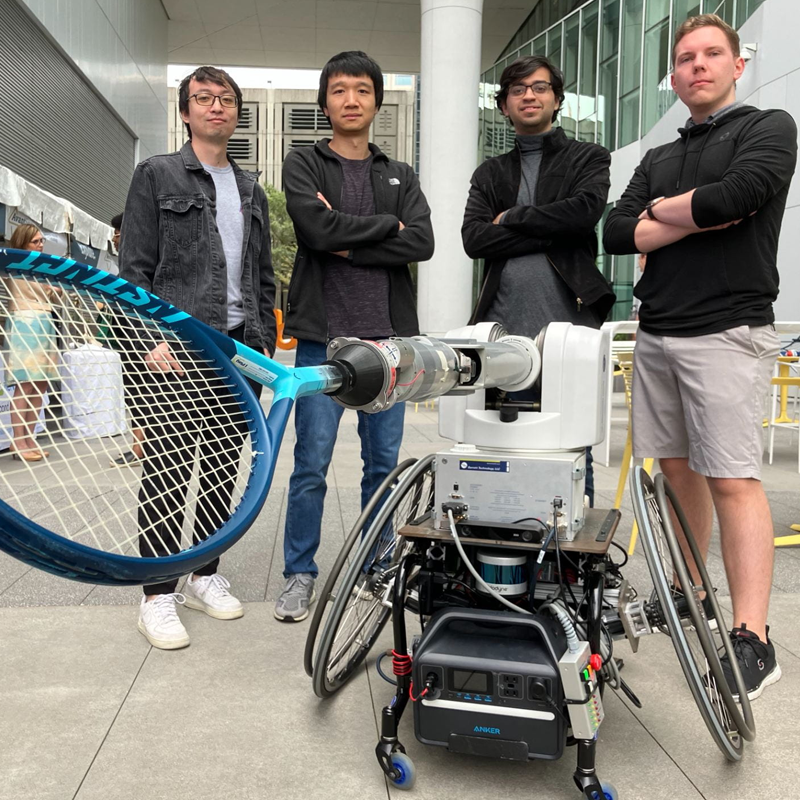
AI & ML for Robotics
At Georgia Tech, we architect the algorithmic foundations of embodied intelligence, empowering autonomous systems to learn from, collaborate with, and safely navigate the physical world.
Artificial Intelligence and Machine Learning are transforming robotics from rigid automation into adaptable, embodied intelligences capable of continuous learning and seamless human-robot teaming. At Georgia Tech, our interdisciplinary ecosystem fuses classical control with deep reinforcement learning, computer vision, and generative AI to solve high-stakes challenges in healthcare, advanced manufacturing, space exploration, and everyday domestic life. By democratizing access to world-class supercomputing and physical testbeds, we accelerate the timeline from foundational algorithmic discovery to real-world, society-scale deployment.
Artificial Intelligence (AI) and Machine Learning (ML) for Robotics represent the pursuit of "embodied intelligence" — the study of cognitive capabilities required to effectively and intentionally interact with our complex physical world. Historically, robotic systems excelled only in highly structured environments, executing rigidly pre-programmed trajectories. Research in robot learning is primarily focused on breaking robots out of such rigid and structured settings, and making them successful in unstructured environments that demand generalization. At Georgia Tech, we are advancing computational approaches, frameworks, and systems that allow robots to perceive unstructured realities, infer the intentions of human collaborators, and autonomously learn complex, long-horizon tasks. Our work spans the spectrum of embodied intelligence, with particular strengths in multi-modal perception, natural language understanding, large-scale models, human-robot interaction, multi-robot teaming, sim-to-real transfer, task and motion planning, safety, and dynamic control.
Impact & Innovation Through Expertise
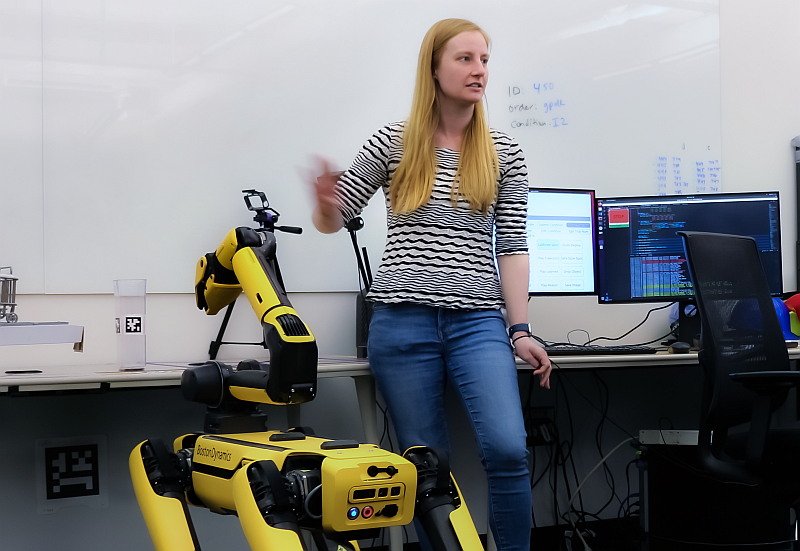
The societal implications of generalizable autonomy are profound. As our global landscape evolves, embodied AI is unlocking transformative solutions across critical sectors. In healthcare and domestic spaces, personalized, assistive robots are being developed to support an aging population, adapting to individual user preferences and providing vital physical and cognitive support. In advanced manufacturing and logistics, intelligent systems are learning to navigate unstructured supply chains and collaborate seamlessly alongside human workers to address acute labor shortages. Furthermore, we are pushing the boundaries of autonomous exploration in extreme environments—from deploying secure, decentralized drone swarms in disaster zones to engineering the navigation systems that will drive next-generation lunar rovers and autonomous space servicing. Reflecting Georgia Tech's leadership in this domain and its global impact, we had the honor and privilege of hosting both CoRL 2023 (the flagship conference in robot learning) and ICRA 2025 in Atlanta (the world's largest robotics conference).
At Georgia Tech, research in AI and ML for robotics is driven by a fundamental question: how can data and knowledge be translated into robust, generalizable, and reliable behavior in the physical world? Across IRIM, algorithms are developed not in isolation, but as components of complete robotic systems, with physical dynamics, human contexts, and resource limitations treated as central design considerations rather than afterthoughts. By combining foundational advances in AI with deep robotics expertise and rigorous evaluation in complex real-world settings, Georgia Tech is advancing robots that are not only more capable, but also more adaptable, trustworthy, and effective in practice.
Translating robotic AI from academic theory to commercial reality requires robust, symbiotic relationships with industry leaders. Our Industrial Partners Program (IP2) provides organizations with strategic engagement, talent pipelines, and collaborative R&D opportunities. Key collaborators driving innovation alongside IRIM faculty include leaders in technology and AI (Meta, Google, Amazon, Qualcomm, Microsoft Research, NVIDIA), aerospace and defense (The Boeing Company, U.S. Army, Department of Energy), and advanced automation (Toyota Research Institute, Boston Dynamics, Honda, Yaskawa, KUKA Robotics).
AI and ML for Robotics SubAreas
Embodied AI and Generalizable Autonomy
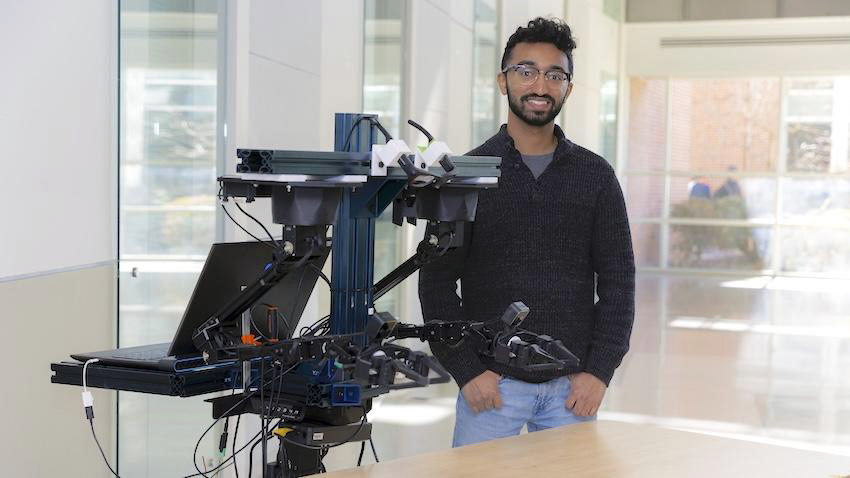
Moving beyond single-purpose machines, this area focuses on building versatile foundation models for robotics. By leveraging massive, multi-modal datasets—including vision, language, and action—researchers develop visuomotor policies that allow robots to generalize cognitive and dexterous skills to entirely novel, unseen environments and objects without requiring expert retraining.
Safe and Trustworthy Robot Learning
The most capable robot in the world is not useful if it cannot be trusted.1 This sub-area pioneers formal safety guarantees, control barrier functions, and certified robot learning. Driven by groups like the Trustworthy Robotics Lab, researchers ensure that learning algorithms remain robust in safety-critical settings and unpredictably dynamic environments.
Human-Robot Teaming and Explainable AI (XAI)
As robots enter human workspaces, true collaboration requires mutual trust. This area pioneers mixed-initiative teaming, where robots and humans fluidly share control. Crucially, researchers develop Explainable AI Planning (XAIP) and semantic inference frameworks that translate complex, "black box" algorithmic decisions into natural language, ensuring robots act predictably and align with human values.
Learning-Enabled Control and Dynamical Systems
Operating at the boundary between data-driven AI and classical control theory, Georgia Tech researchers are building a new generation of controllers. This work combines the flexibility and adaptability of neural networks with the stability and robustness guarantees that real-world deployment strictly demands.
Legged Locomotion and Physical Intelligence
Navigating the real world requires extreme physical adaptability. Fusing nonlinear control theory with deep reinforcement learning, researchers in this area train highly agile quadrupedal and bipedal (humanoid) robots to traverse complex, multi-terrain landscapes. This work emphasizes robust sim-to-real transfer, ensuring simulated agility translates safely to unpredictable physical environments.
Multi-Agent Coordination and Swarm Intelligence
Investigating how decentralized groups of robots can achieve complex global objectives through localized interactions. Research focuses on dynamic resource allocation, capability-aware heterogeneous coordination, and defending cooperative policies against adversarial or fraudulent actors within the swarm's communication network.
Learn More
Contact for AI & ML for Robotics | Harish Ravichandar -Assistant Professor in the School of Interactive Computing | harish.ravichandar@gatech.edu